
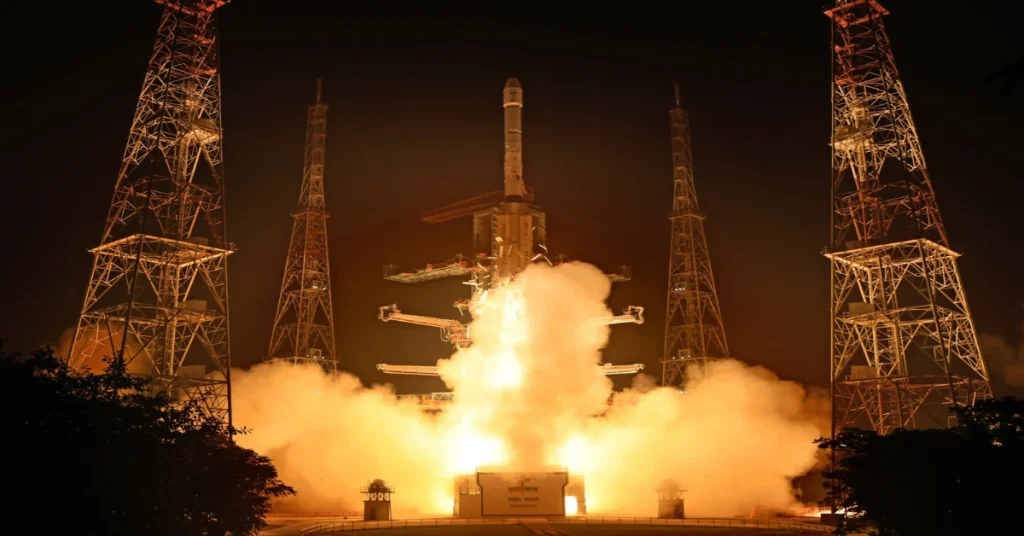
NEW DELHI, October 31, 2026: The Indian Space Research Organisation (ISRO) successfully launched its NVS-03 navigation satellite aboard the GSLV-F18 rocket from Sriharikota on Friday night, placing the spacecraft into its intended geosynchronous transfer orbit. The rocket lifted off at 11:51 p.m. IST from the Second Launch Pad at the Satish Dhawan Space Centre, marking the 20th flight of India’s Geosynchronous Satellite Launch Vehicle.
The mission is an important step towards strengthening NavIC, India’s independent regional satellite navigation system, which has been operating with fewer satellites available for positioning services than it needs. In July, the government told Parliament that only three NavIC satellites were available for positioning, navigation and timing services, against the minimum four required for standalone positioning. NVS-03 could help address that shortfall once it reaches its operational orbit and completes the necessary checks.
NavIC, short for Navigation with Indian Constellation, is India’s satellite-based system for providing location, navigation and precise timing information. It is designed to serve users across the country and in a surrounding region extending approximately 1,500 kilometres beyond India’s borders.
NavIC was developed to give India its own source of navigation and timing signals alongside international systems such as the United States’ Global Positioning System (GPS). However, restoring standalone positioning requires a sufficient number of operational NavIC satellites.
Its intended applications include road transport, maritime navigation, vehicle tracking, location-based services and the precise timing needed for communication and other infrastructure networks.
The October 30 launch placed NVS-03 into a geosynchronous transfer orbit, an elongated path around Earth from which the satellite can be moved towards its final operational position. Successfully reaching this initial orbit is a major part of the mission, but it does not by itself mean that the satellite has begun providing navigation services.
ISRO must still carry out the required orbital manoeuvres, assess the spacecraft’s systems and complete its commissioning before it can be counted as operational for navigation. The agency’s mission announcement confirmed the successful orbital insertion but did not establish that these subsequent steps had been completed.
NVS-03 is the third spacecraft in ISRO’s second-generation navigation satellite series, which is intended to maintain and improve services as older satellites reach the end of their operating lives. The series is planned to include five satellites, designated NVS-01 to NVS-05, which will supplement or replace parts of the existing NavIC network.
The need to replenish that network became particularly clear earlier this year. In a written reply to the Lok Sabha on July 29, Union Minister of State for Space Jitendra Singh said the NavIC constellation had three satellites available for positioning, navigation and timing services: IRNSS-1B, IRNSS-1I and NVS-01.
The government attributed the shortfall to IRNSS-1F completing its 10-year mission life. It said at least four operational satellites were necessary for basic standalone positioning, meaning NavIC could not independently provide that service with the available constellation.
However, the parliamentary reply also made an important distinction. NavIC’s timing service remained functional, and many applications were using receivers capable of combining signals from multiple satellite navigation systems. The shortage therefore did not mean that all navigation devices or services in India had stopped working.
Adding another functioning satellite is intended to improve the constellation’s ability to provide independent positioning information. Whether that capability has been restored will depend on NVS-03 completing its remaining operations successfully.
The latest mission also follows a technical setback involving NVS-02, the second satellite in the next-generation series. Launched aboard GSLV-F15 on January 29, 2025, NVS-02 successfully reached its initial transfer orbit but could not complete the subsequent manoeuvres needed to reach its intended operational position.
In a technical review published in February 2026, ISRO said the problem arose because an electrical command failed to reach a valve associated with the spacecraft’s orbit-raising propulsion system. A review committee identified the most likely cause as the disengagement of electrical contacts in a connector and recommended measures to improve reliability.
ISRO said those corrective measures were successfully implemented on the CMS-03 spacecraft, launched on November 2, 2025, and that the relevant propulsion systems performed satisfactorily. The agency also said the recommendations would be followed in future missions wherever applicable.
The NVS-03 launch therefore comes after efforts to address the technical issues identified in the earlier navigation satellite mission. Its subsequent orbital operations will be particularly important in determining whether the spacecraft can reach its designated position and begin contributing to NavIC services.
Beyond replenishing the constellation, NVS-03 carries technology intended to improve the capabilities of NavIC itself. According to ISRO, the satellite includes an indigenously developed atomic clock alongside other procured atomic clocks.
Atomic clocks are essential to satellite navigation because positioning depends on extremely accurate measurements of the time taken by radio signals to travel from satellites to receivers on the ground. Even very small timing errors can affect the accuracy of the location calculated by a navigation device.
Developing such clocks domestically is significant for a navigation system intended to provide independent services over the long term. It can reduce reliance on foreign suppliers for a component central to the operation of navigation satellites, although the availability of an indigenous clock does not alone establish the performance of the entire system.
Another important feature of NVS-03 is its support for the L1 navigation signal, alongside the L5 and S-band signals used by the NavIC system.
L1 is a radio-frequency band widely used in satellite navigation and supported by many consumer navigation technologies. Adding it to newer NavIC satellites is intended to make the Indian system more compatible with a wider range of civilian receivers, including technology used in smartphones and other location-enabled devices.
That does not mean every smartphone will immediately begin using NVS-03. Devices must have compatible hardware and software, and the satellite must first enter service. Wider adoption will also depend on manufacturers supporting the relevant NavIC signals.
ISRO’s existing navigation programme provides two categories of service: a standard positioning service intended for civilian users and a restricted service for authorised users. Its regional coverage distinguishes it from global navigation systems designed to provide positioning services across the world.
Prime Minister Narendra Modi congratulated ISRO’s scientists and engineers following the successful launch. In a message posted on X on Saturday and reproduced by the Prime Minister’s Office, he said, “This mission marks an important step in strengthening NavIC, our indigenous satellite navigation system.”
Modi also highlighted the satellite’s enhanced capabilities and its intended contribution to India’s development of critical technologies and navigation services.
The GSLV-F18 mission adds to ISRO’s continuing programme of launching replacement and upgraded navigation spacecraft. NVS-01, the first satellite in the second-generation series, was launched in May 2023 and is among the satellites the government identified as available for NavIC services in July.
Two further second-generation satellites, NVS-04 and NVS-05, were reported by the Department of Space in July to be at advanced stages of development. Their eventual deployment is intended to provide additional support for the constellation as India works to maintain reliable navigation and timing coverage.
NVS-03 must next move from its transfer orbit towards its designated operating position and undergo checks of its navigation equipment and onboard systems. Confirmation that these operations have succeeded will be necessary before the satellite’s contribution to restoring standalone NavIC positioning services can be assessed.
Read also : America’s emergency oil stockpile is shrinking: How new exchange deals aim to replenish it
Read also : India’s industrial growth slows to 6.7% despite strong manufacturing and electricity output