

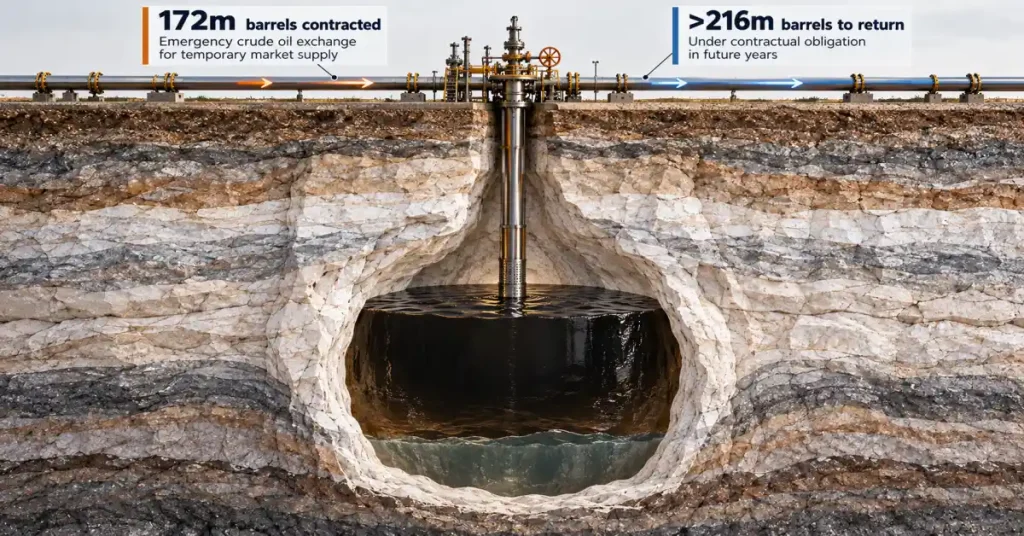
WASHINGTON, October 30, 2026: The United States has completed contract awards covering its commitment to release 172 million barrels of crude oil from the Strategic Petroleum Reserve (SPR), completing the contracting stage of its contribution to an internationally coordinated emergency oil supply programme. The Department of Energy (DOE) announced on Thursday that its latest contract awards cover more than 40 million barrels, including volumes offered through earlier solicitations.
The announcement does not represent a fresh decision to release another 172 million barrels of oil. Instead, it confirms the completion of contracts under an emergency exchange programme already underway. The department also said participating companies are committed to returning more than 216 million barrels to the reserve beginning early next year, including approximately 44 million additional barrels.
The arrangement forms part of a wider effort by member countries of the International Energy Agency (IEA) to make emergency oil stocks available during disruptions to global petroleum supplies. The United States committed 172 million barrels towards a coordinated international action initially covering 400 million barrels.
An important feature of the American programme is that the oil is being supplied through exchanges rather than conventional sales. Under an exchange, companies temporarily receive crude oil from government reserves and agree to return an equivalent quantity, along with additional barrels, at a later date.
This means the government can make oil available to refiners and other market participants during a supply disruption without permanently disposing of the borrowed volume. The additional oil returned by participating companies acts as a premium under the contracts, somewhat like interest on a loan, except that repayment is made in barrels of crude rather than money.
According to the Energy Department, the agreements covering the 172-million-barrel programme provide for the return of more than 216 million barrels. DOE says the agreements provide for approximately 44 million additional premium barrels beyond the oil borrowed, equivalent to roughly 26% of the original 172-million-barrel commitment.
The department valued those additional barrels at more than $4 billion and said the arrangement would involve no additional cost to American taxpayers. These are the department’s stated estimates and financial claims; the announcement did not provide an independent valuation or a detailed accounting of the programme’s eventual costs and benefits.
Kyle Haustveit, the Energy Department’s under secretary, said the latest awards completed the government’s commitment to the emergency programme.
“DOE’s latest awards of more than 40 million barrels complete our commitment to release 172 million barrels from the Strategic Petroleum Reserve,” he said in the department’s October 29 statement.
The announcement follows several earlier rounds of contract awards. On September 29, the Energy Department sought bids for an exchange of up to 40 million barrels, building on five previous solicitations that had collectively resulted in awards covering more than 133 million barrels.
The latest announcement brings that contracting process to its stated target. However, the more than 40 million barrels covered by the October 29 disclosure should not be treated as an entirely new volume added on top of the earlier releases.
The Energy Department said crude oil under the newly announced contracts would come from the Big Hill and Bryan Mound storage sites. Both are part of the Strategic Petroleum Reserve’s network of underground storage facilities along the US Gulf Coast.
The reserve stores crude oil in large underground caverns formed within salt deposits. It was established following the oil supply disruptions of the 1970s to provide an emergency source of petroleum when commercial supplies are interrupted.
Unlike ordinary commercial oil inventories, which are managed primarily according to business requirements, the Strategic Petroleum Reserve serves a national energy security purpose. Its oil can be made available under authorised government actions to respond to serious supply interruptions and other qualifying circumstances.
Moving crude from the reserve into the market requires more than signing a contract. Oil must be withdrawn from storage, transported through pipelines or marine terminals and delivered to participating companies or refineries. The Energy Department said it would coordinate with contract holders, pipeline operators, terminals and refining partners to manage those movements.
That distinction is important because the completion of contract awards does not establish that every barrel covered by the 172-million-barrel commitment has already reached the market. The department’s September announcement had scheduled deliveries under the relevant exchanges for November and December 2026, while its latest statement did not provide a complete, updated delivery timetable.
The wider international programme began in March 2026, when the IEA’s 32 member countries agreed to make 400 million barrels of emergency oil available in response to disruptions associated with the conflict in the Middle East.
The coordinated action was intended to increase the availability of crude oil and petroleum products during a period of pressure on global energy supply. Emergency stock releases can provide additional barrels to the market, although their effect on prices depends on the scale and duration of supply disruptions, demand and other market conditions.
The International Energy Agency has also warned that the global supply problem extends beyond crude oil. Its October assessment found continued pressure on diesel supplies because of refinery disruptions, reduced shipments of refined petroleum products and constraints on international transportation. Although some crude oil exports from the Middle East had recovered, the availability of refined fuels remained under pressure.
Consequently, releasing additional crude oil can help address immediate supply shortages but cannot, by itself, resolve constraints on fuel production and distribution. Refineries must be able to process the crude into usable fuels, while transportation networks must be available to deliver those products to consumers.
The international programme was still being implemented in October. In an October 15 update, the IEA said approximately 330 million barrels had been released and that member countries were working to accelerate the remaining commitments.
The agency said around 100 million barrels of further releases were planned, including more than 20 million barrels of diesel. It also noted that some countries had released more oil than initially pledged or intended to do so. Consequently, the final quantity made available under the collective action could exceed its original 400-million-barrel target.
The latest US contract awards therefore mark the completion of the American contracting commitment, not necessarily the completion of physical oil deliveries across all participating countries.
The programme also comes at a time when the US emergency stockpile has been substantially reduced. According to the US Energy Information Administration (EIA), the Strategic Petroleum Reserve held 282.58 million barrels of crude oil on October 23, its lowest level since 1982. The stockpile had stood at approximately 413.33 million barrels on April 3, highlighting the scale of withdrawals during 2026.
The decline makes the timetable for returning borrowed oil particularly important. Although the exchange agreements are designed to replenish the reserve with more crude than was released, those additional barrels will not be available until the contractual returns take place.
Under the agreements, companies must replace the crude they receive and provide additional premium barrels, with repayments expected to begin in early 2027. However, the projected return of more than 216 million barrels is a contractual commitment, not an amount already restored to storage.
Actual replenishment will depend on participating companies meeting their obligations and the government receiving the oil according to the agreed schedules. The department’s October 29 announcement did not provide a complete timetable showing when all the expected barrels would be returned.
For the global oil market, the immediate significance of the October 29 announcement is that the United States has completed another stage in implementing its previously announced emergency supply contribution. The next developments to watch are the delivery of the remaining contracted crude, the progress of other IEA member countries and the return of borrowed barrels to the US reserve beginning next year.
Read also : India launches Punah Bharan app to find groundwater recharge zones within 3 km: how it works
Read also : India’s telephone connections rise to 136.79 crore: why the total includes more than mobile phones