
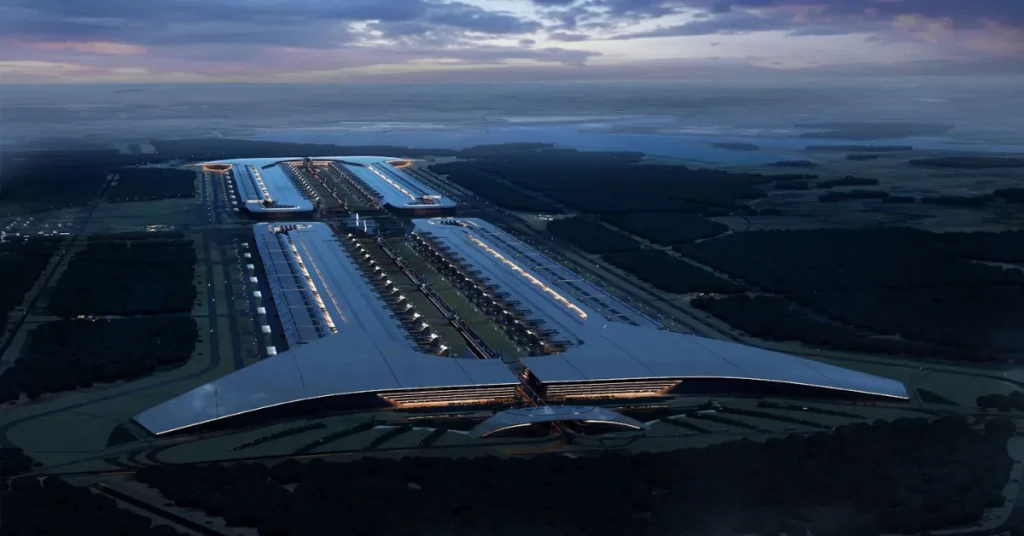
Terafab is being pitched as a chipmaking system for Tesla, SpaceX and Musk’s expanding AI ambitions. Its proposed scale invites comparisons with TSMC — but building huge fabs is only the beginning of the semiconductor challenge.
For most technology companies, needing more advanced chips means placing a bigger order with somebody else.
Elon Musk has a more characteristically ambitious answer: build the chips himself.
In Grimes County, Texas, SpaceX and Tesla are planning Terafab, an enormous semiconductor manufacturing complex meant to produce computing hardware for everything from Tesla’s self-driving vehicles and Optimus humanoid robots to SpaceX’s proposed computing systems in orbit.
SpaceX says the initial phase is estimated to require about $16.8 billion in capital investment, while the full complex is planned with more than 100 million square feet of manufacturing space and at least 3,000 jobs. Earlier Texas filings contemplated a multi-phase buildout whose investment could reach $119 billion if additional phases are completed.
Numbers like those inevitably invite comparison with Taiwan Semiconductor Manufacturing Company, or TSMC — the company at the centre of modern advanced chipmaking.
But is Terafab really Musk’s attempt to build another TSMC? Not exactly. And that distinction is what makes the project interesting.
What exactly is Terafab?
A semiconductor fabrication plant, shortened to “fab”, is where silicon wafers pass through hundreds of tightly controlled steps before becoming the chips inside phones, cars, servers and AI systems.
Terafab expands that idea. SpaceX says the Texas complex is intended to put the manufacturing, packaging and testing of advanced logic and memory devices in one location. In securities filings, it describes an even wider closed-loop system spanning lithography-mask design, chip fabrication, advanced packaging and rapid testing.
In plain English, Musk does not just want a factory that prints processors. The ambition is to shorten the distance between designing a chip, making it, packaging it, testing it and feeding what engineers learn into the next version.
The intended customers sit largely inside Musk’s own ecosystem. Terafab’s official site points to AI5 chips for Tesla’s Full Self-Driving and Optimus, AI6 for Optimus, and D3 chips for space applications. It says the factory is being designed for both Earth and orbit.
The logic is less “let us compete for Apple’s next chip order” and more “what if Tesla and SpaceX eventually cannot buy enough chips for themselves?”
Why TSMC is the unavoidable comparison
TSMC is the clearest benchmark for understanding how difficult — and valuable — advanced semiconductor manufacturing has become.
Founded in 1987, TSMC pioneered the pure-play foundry model. Chip designers bring it their designs; TSMC manufactures the silicon. That model allowed companies to become world-class chip designers without spending tens of billions of dollars operating their own leading-edge factories.
The scale today is extraordinary. In 2025, TSMC manufactured 12,682 different products for 534 customers using 305 process technologies. Annual capacity across facilities managed by TSMC and its subsidiaries exceeded 17 million 12-inch-equivalent wafers.
Counterpoint Research estimated TSMC held a 73% share of the pure-foundry market in the second quarter of 2026. In the same quarter, TSMC reported $40.2 billion in revenue; 2-nanometre chips already contributed 3% of wafer revenue and 3nm another 30%.
That exposes the central difference. TSMC is an operating industrial giant serving hundreds of customers. Terafab is a manufacturing system still being built, largely to support Musk-linked companies.
TSMC makes chips for much of the technology industry. Terafab wants to make one business empire less dependent on it.
Why Musk thinks he needs Terafab
Musk’s argument starts with future demand.
Tesla wants increasingly capable autonomous vehicles and potentially vast numbers of Optimus robots. SpaceX is simultaneously pushing towards far more computing in orbit. SpaceX says combined future chip demand from Tesla and SpaceX is expected to exceed one terawatt of compute — a projection it says is significantly larger than current global supply.
That one-terawatt number needs care. Watts measure power; chip fabs are more commonly discussed in wafer starts, yields and packaged-chip output. It is therefore better understood as a measure of the computing infrastructure Musk wants to support than as a direct production comparison with TSMC.
SpaceX also says Terafab will not eliminate outside suppliers. Its SEC disclosures say the company expects to keep sourcing significant quantities of compute hardware from third parties.
Terafab, then, looks less like a replacement for the semiconductor industry and more like an enormous captive source of additional capacity.
Before the mega-fab comes a $3 billion laboratory
Musk is not jumping directly from ordering chips to operating a 100-million-square-foot semiconductor empire.
Tesla broke ground in April on a smaller research fab at the North Campus of Giga Texas. Musk has said it would cost roughly $3 billion and handle only a few thousand wafer starts per month. Its purpose is experimentation: testing manufacturing ideas before attempting them at much greater scale.
Reuters described it as a precursor to large-scale Terafab. That matters because semiconductor manufacturing punishes companies that try to learn at full scale. A process that looks elegant in simulation still has to survive contamination, heat, lithography, materials and production defects.
Intel may be the most important partner
Tesla knows cars, batteries, software and AI systems. SpaceX knows rockets and satellites. Neither has decades of experience running a leading-edge semiconductor process.
Intel does.
Intel joined the project in April, with SpaceX saying the chipmaker is expected to contribute expertise in designing, fabricating and packaging ultra-high-performance chips.
Musk has said Tesla plans to use Intel’s next-generation 14A process. Intel describes 14A as using RibbonFET 2 and PowerDirect technologies to improve performance, power efficiency and density.
The jargon matters less than what the relationship represents: Intel brings manufacturing knowledge that cannot be created simply by writing a larger cheque.
It also highlights the gap between aspiration and incumbency. TSMC’s 2nm process is already generating commercial revenue; in the second quarter of 2026, 2nm accounted for 3% of its wafer revenue. Intel 14A remains a next-generation process being prepared for future customers.
The hardest word in chipmaking is ‘yield’
A company can buy land, construct clean rooms and order extraordinarily expensive lithography equipment. None of that guarantees it can manufacture advanced processors economically.
The crucial concept is yield.
Imagine a silicon wafer carrying hundreds of chips. If too many emerge defective, the cost of every working chip rises. A successful fab must therefore control thousands of variables and repeatedly produce a high percentage of usable devices.
Doing that once is difficult. Doing it at enormous volume while moving to newer processes is where companies such as TSMC have accumulated decades of institutional knowledge.
This is why factory size alone can mislead. TSMC’s advantage is not just its buildings and equipment; it is process knowledge, supplier relationships, manufacturing discipline and years of yield learning.
Terafab cannot buy that history by the square foot. It has to create its own.
How extreme is the one-terawatt bet?
The scale Musk talks about has already prompted scepticism from semiconductor analysts.
Bernstein analysts estimated that enough chip capacity to support the one-terawatt ambition could require $5–13 trillion in capital expenditure, depending on the assumptions used.
That is not a forecast for the announced Texas complex. It is an attempt to translate Musk’s much larger long-term target into conventional semiconductor economics. But it illustrates the distance between the vision and the factories being funded today.
TSMC provides another useful yardstick. Its Arizona programme has expanded to a planned $265 billion US investment, with six logic fabs, two advanced-packaging facilities and an R&D centre in current plans.
Terafab can therefore be one of the most ambitious new semiconductor projects on Earth while still entering an industry where the incumbent already operates at staggering scale.
A giant fab also means giant local consequences
A complex this large does not arrive quietly.
Grimes County’s approval of tax incentives drew fierce opposition. A June hearing attracted more than 100 residents, with speakers raising concerns about water and power supplies, wildlife, light pollution and the transformation of the county’s rural character.
The planned site is near Gibbons Creek Reservoir, and the companies plan to use reservoir water instead of local groundwater for industrial operations.
That debate is another reminder that advanced chipmaking is not simply about silicon. It requires land, electricity, water, specialised infrastructure, suppliers and a skilled workforce. Terafab is effectively an attempt to build part of the physical industrial base behind Musk’s AI ambitions.
So, is Terafab really Musk’s TSMC?
No — at least not in the conventional sense.
TSMC became indispensable by creating a manufacturing platform trusted by hundreds of chip designers. Terafab is being conceived primarily as a vertically integrated manufacturing engine for Musk-linked businesses.
TSMC’s job is to manufacture other companies’ semiconductor ambitions.
Terafab’s job is to make sure Musk’s ambitions do not run out of chips.
That may prove exceptionally difficult. SpaceX itself warns in regulatory filings that there is no assurance Terafab succeeds on its expected timetable — or at all.
But Terafab does not have to dethrone TSMC to matter. If Tesla, SpaceX and Intel can move even a meaningful share of Musk’s future semiconductor demand into a manufacturing system they can influence directly, his companies gain something increasingly valuable in the AI era: greater control over the hardware beneath everything else.
And if the larger vision works — logic, memory, packaging and testing tied together at enormous scale — the more interesting question may eventually stop being whether Musk has built another TSMC.
It may be whether Terafab has built a different model for the factories behind the AI age.
Terafab is being pitched as a chipmaking system for Tesla, SpaceX and Musk’s expanding AI ambitions. Its proposed scale invites comparisons with TSMC — but building huge fabs is only the beginning of the semiconductor challenge.