
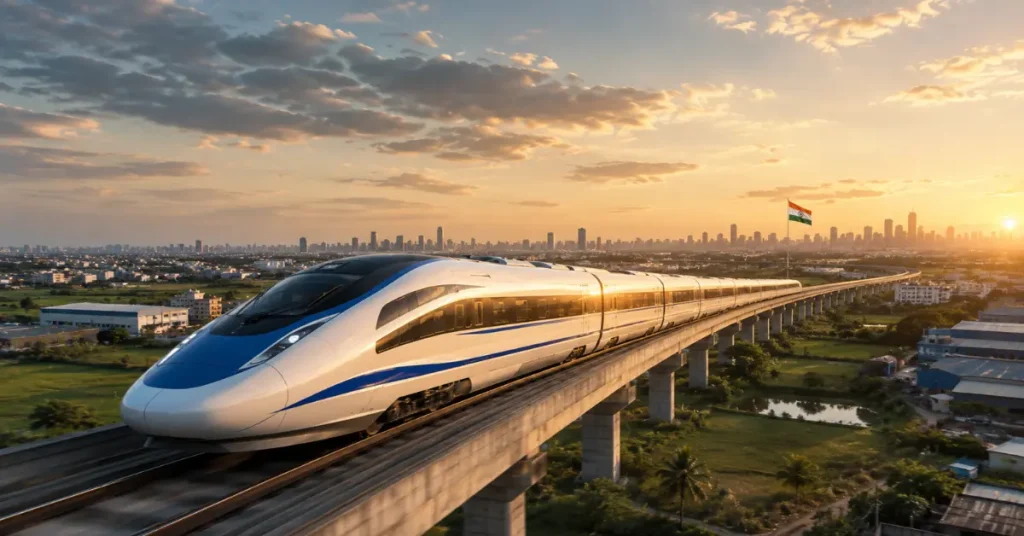
India’s first bullet-train project is being used for more than establishing a high-speed rail link between Mumbai and Ahmedabad, with the engineering methods, technical specifications and institutional experience developed during its construction are now being converted into a common blueprint for the country’s proposed high-speed rail network.
The National High Speed Rail Corporation Limited (NHSRCL), which is the implementing agency for the bullet train project, is developing a standardised design library for future viaducts, bridges, tunnels and stations under the Bharat High-Speed Rail Programme, the government has informed the Parliament.
“Based on the MAHSR project, a standardised template is being developed for upcoming bullet train corridors across the country. The approach aims to implement proven engineering designs, construction methods, and operational practices. It will improve efficiency and accelerate project execution. TheMAHSRproject is thus laying the foundation for a transformation,” the government had earlier said in a statement.
The agency is being supported by leading technical institutions, including the Indian Institutes of Technology, in the exercise.
Further, NHSRCL is also working on specifications for a train-control system capable of supporting speeds up to 350 kmph, with a focus on domestic development and adaptation to Indian environmental and social conditions.
“The Mumbai–Amdavad High Speed Rail (MAHSR) project, India’s first bullet train project, is a large and technologically complex undertaking, designed to deliver safe, reliable, comfortable, and cost-effective operations at 320 km/h, with all major civil structures engineered for a design speed of 350 km/h,” Railways Minister Ashwini Vaishnaw said in a written reply to a question in the Rajya Sabha.
“Based on the experience gained from this project, National High Speed Rail Corporation Limited (NHSRCL) has taken up activities for a standardised set of designs and technical specifications for the Infrastructure of future corridors, such as viaducts, bridges, tunnels and stations,” the minister said.
Towards this, NHSRCL is developing design library under the Bharat High Speed Rail Programme and involved leading technical institute like IITs, Vaishnaw said.
“NHSRCL is simultaneously under process of developing specification for Train control system for speed upto 350 kmph with focus on Make in India (MII) suiting Indian environmental and social condition,” the minister said.
The framework is intended to support seven high-speed rail corridors announced in the Union Budget 2026–27, covering nearly 4,000 km.
Instead of designing every component afresh for each corridor, the government wants to reuse proven systems wherever geographical and engineering conditions permit.
What Exactly Is Being Standardised?
High-speed rail projects involve considerably more than laying tracks and purchasing faster trains.
They require dedicated alignments, precision-built viaducts, specialised bridges and tunnels, ballastless tracks, advanced electrification and signalling, automated train control, earthquake-detection systems and tightly controlled maintenance procedures.
The Mumbai–Ahmedabad High-Speed Rail project is providing India with its first large-scale experience of constructing and integrating these systems.
Under the proposed model, standard engineering specifications would be prepared for components such as:
- Piers and elevated viaducts
- Bridge structures
- Ballastless track systems
- Station structures and passenger facilities
- Tunnels and associated safety systems
- Overhead electrification
- Signalling and train control
- Inspection and maintenance procedures
However, standardisation does not mean that every station, tunnel or bridge across India will have an identical design.
Foundations, for example, would continue to be designed according to soil, seismic, hydrological and topographical conditions at each location.
Once these site-specific factors are addressed, common designs can be used for repeatable elements such as piers, viaduct spans, track structures, electrification equipment and station modules.
This could reduce repeated design work and simplify procurement, training, spare-parts management and maintenance.
Why Does India Need A Common Blueprint?
Each major railway corridor is normally designed around its own geography, demand pattern and engineering challenges.
However, starting every future high-speed rail project with an entirely new set of technical specifications would increase the time required for design reviews, tender preparation, vendor development and safety approvals.
Proven modular designs could allow future projects to move more quickly from planning to procurement and construction, as contractors would work with familiar specifications, while manufacturers could produce standard components in larger numbers instead of developing separate products for each corridor.
A common system could also make long-term operation easier. Engineers and technicians trained on one corridor would be familiar with systems used elsewhere, while commonly used parts could reduce the complexity of maintaining a geographically dispersed network.
“Design standardisation is essential for safety, quality, cost optimisation, and rapid project delivery. Proven, modular designs eliminate the need to redesign each corridor, enabling faster execution and consistent construction and maintenance standards across the network,” the minister said in the statement.
“It also provides the foundation for developing indigenous HSR standards, reducing costs while strengthening India’s domestic engineering capability. This approach will help deliver world class high-speed rail infrastructure across the seven new corridors of about 4,000 km announced in the Union Budget 2026-27,”
The approach is particularly significant because the seven proposed corridors would represent a much larger programme than the 508-km Mumbai–Ahmedabad project.
The government has previously estimated that the proposed network could involve investment of around Rs 16 lakh crore, although final costs will depend on the individual DPRs, alignments and financing structures.
Which Seven Corridors Have Been Proposed?
The Union Budget 2026–27 announced the development of the following routes:
| Proposed corridor | Indicative travel time stated by government |
| Mumbai–Pune | 48 minutes |
| Pune–Hyderabad | 1 hour 55 minutes |
| Hyderabad–Bengaluru | 2 hours |
| Hyderabad–Chennai | 2 hours 55 minutes |
| Chennai–Bengaluru | 1 hour 13 minutes |
| Delhi–Varanasi | 3 hours 50 minutes |
| Varanasi–Siliguri | 2 hours 55 minutes |
Together, the routes are intended to connect major business, technology, manufacturing and tourism centres across the country.
The southern corridors would create a high-speed network linking Mumbai, Pune, Hyderabad, Bengaluru and Chennai, while the Delhi–Varanasi and Varanasi–Siliguri routes would extend high-speed connectivity towards northern and eastern India.
What Has India Learned From Mumbai–Ahmedabad?
The Mumbai–Ahmedabad corridor uses Japanese Shinkansen technology and is designed for an operating speed of 320 kmph, with major civil structures designed for 350 kmph.
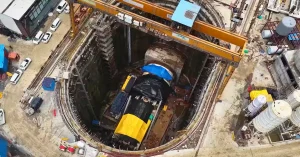
The project has required Indian agencies and companies to develop capabilities in elevated high-speed viaduct construction, J-Slab ballastless track installation, specialised bridge launching, underground station construction, tunnelling, high-speed electrification and precision engineering.
According to the latest parliamentary disclosure, the entire 1,389.5 hectares required for the project has been acquired, all statutory clearances have been obtained and 1,651 affected utilities have been shifted.
The construction progress of the Mumbai-Ahmedabad bullet train project detailed in the minister’s response, includes:
- Piers completed across 452 km
- Girders completed across 356 km
- Track bed completed across 209 km
- Overhead electrification masts erected across 190 km
- Around 4.8 km completed on the approximately 21-km Maharashtra tunnel section
- Civil works completed on the 97-km Surat–Vapi section, with most of its track bed laid
Work has also progressed across the project’s 12 stations and 25 river bridges, although the level of completion varies substantially between Gujarat and Maharashtra, as the latter faced issues in the land acquisition for the project.
The government has said that the first high-speed rail service is expected on the Surat–Vapi section in August 2027.
The entire Mumbai–Ahmedabad corridor is likely to be completed by the end of 2029.
How Much Of The Technology Will Be Made In India?
The Mumbai–Ahmedabad corridor is being built with technical and financial assistance from Japan so its initial systems draw heavily on established Shinkansen technology and operating practices.
At the same time, the project is being used to build a domestic ecosystem of engineers, contractors and manufacturers.
Indian companies have produced specialised construction machinery, track components and equipment required for viaduct and slab-track construction.
Around 1,000 Indian engineers and skilled workers have also received training in Japanese construction methodologies.
The development of India-specific train-control specifications for speeds up to 350 kmph represents a further step towards localisation.
A train-control system supervises train movement, maintains safe separation, communicates speed and movement authorities and initiates automatic intervention when necessary.
Developing common domestic specifications would allow future corridors to avoid depending entirely on separate proprietary systems.
Separately, Integral Coach Factory and BEML are developing an indigenous high-speed trainset designed for 280 kmph.
Further, the government also plans to develop another high-speed train with design speed of 350 kmph.