
Summary: Sodium-ion cells are reaching production lines, solid-state batteries are undergoing road tests and researchers are reporting lithium-metal cells with extraordinary energy density. None, however, is ready to replace lithium-ion everywhere.
For years, the battery industry has been waiting for a successor to lithium-ion: a cheaper, safer battery that charges in minutes, lasts for decades and packs enough energy to make electric aircraft practical.
That successor has not appeared. Something more interesting has.
In February, CATL and Chinese carmaker Changan unveiled what the companies described as the first mass-production passenger vehicle powered by sodium-ion batteries.
In June, Stellantis and Factorial began road-testing solid-state cells in a Dodge Charger Daytona development vehicle.
QuantumScape, another solid-state developer, opened an automated pilot line in California to make cells for customer testing and to show that its manufacturing process can be scaled.
Meanwhile, laboratories have reported silicon-based lithium-ion cells exceeding 400 watt-hours per kilogram, lithium-metal cells crossing 600 Wh/kg and lithium-sulphur cells reaching 435 Wh/kg. On the electricity grid, iron-air systems are being prepared to store power for as long as 100 hours.
It is tempting to read these developments as signs that lithium-ion is approaching retirement.
That would be premature.
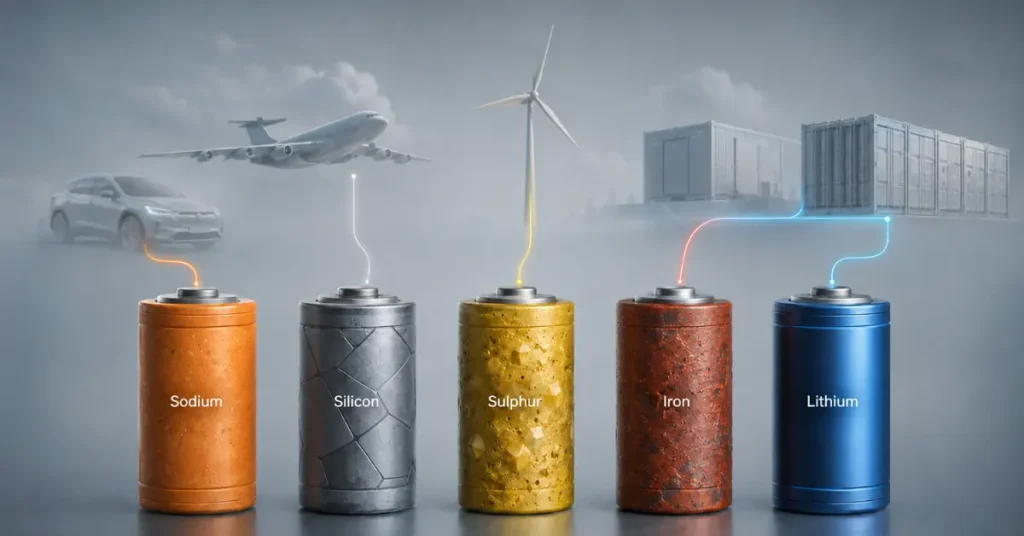
The evidence instead points to a battery market dividing by purpose. The battery best suited to a family car may be a poor choice for an aircraft. A chemistry that makes little sense in a phone could work well beside a solar farm. Cost, weight, safety, charging speed and operating life matter differently in each case.
The next phase of the battery industry may therefore have several winners, not one.
Lithium-ion is still the battery to beat
The first reality check comes from the market.
Electric vehicles accounted for more than 70 per cent of global battery deployment in 2025.
EV battery demand reached about 1.2 terawatt-hours, nearly 30 per cent higher than a year earlier and more than seven times its 2020 level, according to the International Energy Agency’s Global EV Outlook 2026. Average battery prices fell by another 8 per cent during the year.
Lithium-ion is not one fixed technology. The name covers several combinations of electrode materials, each making a different compromise.
Nickel-rich batteries, including nickel-manganese-cobalt or NMC cells, generally store more energy for their weight. That makes them useful in vehicles where range and battery size command a premium.
Lithium iron phosphate, or LFP, sacrifices some energy density but offers lower material costs and a long operating life. It also avoids nickel and cobalt.
LFP supplied more than 55 per cent of the batteries installed in electric vehicles worldwide in 2025. It accounted for more than 90 per cent of global stationary battery-storage installations. Average LFP battery packs were more than 40 per cent cheaper per kilowatt-hour than NMC alternatives, although part of that difference reflects LFP’s heavy use in stationary systems where weight is less important. These figures come from the IEA’s analysis of global battery deployment and prices.
This is the hurdle facing every new chemistry. It is not competing with the lithium-ion battery of ten years ago. It is competing with a technology manufactured at enormous scale, supported by established suppliers and still improving.
Sodium-ion reaches the factory floor
Of the alternatives now attracting attention, sodium-ion has the clearest path to large-scale production.
A sodium-ion cell works in much the same way as a lithium-ion battery, with charged ions moving between two electrodes. Sodium is far more abundant than lithium, and sodium-ion cells can avoid lithium and graphite. They can also use aluminium instead of copper for one of the current collectors.
The trade-off is energy density. Sodium atoms are larger and heavier than lithium atoms, making it harder to store the same amount of energy in the same space.
The latest sodium-ion cells reach up to 175 Wh/kg, compared with about 205 Wh/kg for the latest LFP cells and 265 Wh/kg for high-nickel NMC cells, according to the IEA’s 2026 battery assessment. In a vehicle, that difference generally means a larger battery or a shorter driving range.
CATL says its Naxtra sodium-ion cell can reach 175 Wh/kg. The company also says its sodium-ion production lines have been commissioned and that deliveries of its first stationary storage systems will begin in China in September 2026.
CATL expects shipments to reach 1 GWh by the end of the year, according to its July announcement.
Those are company targets; completed deliveries will provide the more meaningful commercial test.
CATL and storage-system manufacturer HyperStrong have also announced a three-year agreement covering 60 GWh of sodium-ion batteries. Again, an order of that size is evidence of commercial intent, not evidence that the full volume has already been produced or installed.
Sodium-ion also has an advantage in extreme cold. The IEA says the latest cells can retain about 90 per cent of their nominal capacity at temperatures as low as minus 40 degrees Celsius. A separate 2026 peer-reviewed study demonstrated a 1.2 Ah sodium-ion pouch cell delivering 163 Wh/kg at room temperature and continuing to operate at minus 50 degrees Celsius under laboratory conditions.
That could make the chemistry attractive for cold-climate vehicles, industrial equipment and stationary storage. It may also be used in hybrid battery packs that combine sodium-ion and lithium-ion cells.
Yet sodium-ion is not automatically cheaper simply because sodium is abundant. Electrode processing, hard-carbon anodes, factory yields and supply-chain scale all contribute to the final price.
Current sodium-ion manufacturing capacity is only a little more than 1 per cent of lithium-ion capacity. Announced sodium-ion projects for 2030 amount to roughly 7 per cent of committed lithium-ion capacity, while most of the sodium-ion supply chain is concentrated in China, the IEA says.
Sodium-ion has crossed from research into industrial strategy. It has not yet displaced LFP on cost, scale or energy density.
Solid-state batteries enter vehicles, but remain a manufacturing problem
Solid-state batteries have generated the greatest expectations because they promise to change two parts of the cell at once.
Conventional lithium-ion batteries use a liquid electrolyte to carry ions between the electrodes. A solid-state battery replaces some or all of that liquid with a solid material. This could make it possible to use lithium metal instead of graphite at the negative electrode, increasing the amount of energy stored for a given weight.
The difficult part is keeping solid materials in contact as the battery charges, discharges, heats, cools and expands.
Factorial says the 77 Ah cells used in its Stellantis development programme previously demonstrated 375 Wh/kg, charged from 15 to 90 per cent in 18 minutes and operated between minus 30 and 45 degrees Celsius. These are results reported by the companies. The road-testing programme announced on June 11 is intended to test performance, reliability and safety inside a working vehicle.
Moving a cell into a development car is a genuine engineering milestone. It is not the same as producing millions of affordable cells.
QuantumScape’s Eagle Line illustrates that distinction.
The company says the line will manufacture cells for customer sampling, product integration and technology demonstrations.
It is also intended to show prospective licensing partners how the process might eventually operate at gigawatt-hour scale. The company’s own description of the facility makes clear that it is a pilot line, not a high-volume commercial factory.
Toyota continues to target 2027 or 2028 for the initial commercialisation of all-solid-state batteries in electric vehicles, followed by broader mass production. That timetable comes from Toyota and Idemitsu’s official cooperation announcement, rather than from vehicles already in customer use.
The science is still exposing failure mechanisms.
A Nature Nanotechnology paper published in July 2026 found that grain boundaries in a type of ceramic solid electrolyte could conduct electrons more readily than the surrounding material.
The imbalance encouraged lithium to form inside the electrolyte, increasing the risk of an internal short circuit.
Another Nature paper published the same month examined how lithium dendrites begin and spread through solid electrolytes.
Solid-state batteries are therefore no longer merely a laboratory idea. But their future will be decided less by a record set in a single cell than by manufacturing yield, defect control, operating pressure and cost.
Silicon could arrive sooner by improving the battery already in use
Not every important advance requires a new battery chemistry.
Most lithium-ion batteries use graphite at the negative electrode. Silicon can store far more lithium than graphite, but it swells dramatically during charging. Repeated expansion and contraction can fracture the material and break electrical connections inside the electrode.
Manufacturers already add modest amounts of silicon to some graphite anodes. The harder task is increasing the silicon content without shortening battery life.
A Nature Communications paper published in 2026 reported a 1.26 Ah silicon-monoxide pouch cell that reached 402 Wh/kg and operated for 500 cycles at a 2C rate.
The researchers strengthened the silicon material to limit mechanical damage while improving the movement of lithium through it.
It remains a research cell, not a finished automotive product. But its format and capacity make the result more relevant than a test conducted only in a tiny coin cell.
Silicon also has an industrial advantage: it can be introduced into the familiar lithium-ion design. Manufacturers would still have to change materials and production processes, but they would not necessarily need to replace the entire battery architecture.
That makes silicon-rich anodes one of the more plausible routes to higher-energy commercial batteries before fully solid-state cells become widely available.
What a 600 Wh/kg battery headline does not tell you
Lithium metal offers a bigger potential increase.
Graphite stores lithium inside its structure. A lithium-metal battery uses metallic lithium directly, reducing the amount of inactive weight at the negative electrode. It can therefore deliver far higher specific energy.
In April, researchers reported a 14 Ah lithium-metal pouch cell reaching 606.8 Wh/kg. The cell retained 92.9 per cent of its initial capacity after 75 cycles.
The figure is remarkable. The test conditions are just as important.
The cell was cycled at charge and discharge rates of 0.1C and 0.2C, far gentler than routine fast charging. Seventy-five cycles would also be inadequate for a passenger vehicle expected to operate for years.
A separate 2025 study reported an 11 Ah solid-state lithium-metal cell delivering 604.2 Wh/kg and retaining 92.83 per cent of its energy after more than 100 cycles under lean-electrolyte conditions. Once again, the result demonstrated what the chemistry might achieve, not what a commercial car battery can already deliver.
Lithium metal is reactive. It can form needle-like dendrites, lose contact with the electrolyte and create safety problems. A commercially useful cell must tolerate fast charging, temperature changes, vibration and manufacturing defects while surviving hundreds or thousands of cycles.
The first serious markets may therefore be aircraft, drones, defence systems and other applications where saving weight is valuable enough to justify a higher price or a shorter operating life.
Lithium-sulphur is chasing the same weight-sensitive market
Lithium-sulphur batteries replace the heavy metal-oxide cathode used in conventional lithium-ion cells with sulphur.
Sulphur is abundant and light, giving the chemistry very high theoretical energy density. Its practical weakness is that intermediate sulphur compounds can dissolve into the electrolyte and move between the electrodes, wasting active material and degrading the cell.
A 2026 Nature Communications paper reported a 13.2 Ah lithium-sulphur pouch cell with a specific energy of 435 Wh/kg. The researchers used a catalyst intended to accelerate sulphur reactions and limit the movement of soluble polysulphides.
That is a substantial cell, but one strong result should not be mistaken for the average state of the technology.
A 2025 benchmarking study examined performance data from 184 lithium-sulphur research papers. The most energy-dense design in the dataset reached 441 Wh/kg, while the median was 298 Wh/kg. Much of the evidence still came from coin cells, and the researchers found that increasing sulphur loading could actually reduce usable energy when ion transport and reaction efficiency suffered.
Lithium-sulphur may not need to match the life of an LFP battery to find a market. An electric aircraft or long-endurance drone could benefit greatly from lower battery weight. An inexpensive city car or a grid-storage site would usually value durability and cost more highly.
The electricity grid needs a different kind of battery
Much of the debate around future batteries begins with cars. Electricity grids present a different engineering problem.
A vehicle battery must be compact, light and capable of producing sudden bursts of power. A grid battery can occupy rows of containers. It can charge slowly and weigh thousands of tonnes if the system is affordable, safe and long-lived.
LFP is already well suited to storing solar electricity in the afternoon and releasing it during the evening. Keeping power available through several days of weak wind or limited sunshine requires much longer discharge times.
Form Energy is developing an iron-air battery designed to discharge for as long as 100 hours. The system uses a reversible version of rusting: iron combines with oxygen during discharge, and an electric current reverses the reaction during charging.
The company says its first commercial demonstration with Great River Energy has been installed, with the full project expected to come online during 2026. That status and timetable appear on Form Energy’s company history page.
The US Department of Energy is also supporting a proposed demonstration involving two 10 MW iron-air systems, each designed for 100 hours of discharge, at retiring coal-plant sites in Colorado and Minnesota. These projects are demonstrations; they have not yet established decades of operating performance or final commercial costs.
Zinc batteries offer another possible route. Zinc is relatively abundant, and aqueous batteries use water-based electrolytes that can reduce some fire risks associated with organic liquid electrolytes.
A 2026 zinc-iodine study reported a pouch cell with about 1.5 Ah of capacity operating for more than 200 cycles. The researchers addressed dendrite formation and unwanted reactions involving water, two persistent problems for rechargeable zinc-metal cells. It remains a laboratory result rather than a utility-scale system.
Flow batteries separate the energy-storing liquids from the cell stack and hold them in external tanks. Increasing the size of the tanks can extend storage duration without redesigning the entire power-producing part of the system.
A 2025 study of a zinc-iodine flow battery reported 500 cycles over 2,000 hours under the researchers’ test conditions. Flow systems avoid some of the packaging constraints faced by vehicle batteries, but they must still compete on pumps, membranes, maintenance, electrolyte cost and total system efficiency.
These batteries may never produce attractive numbers in watt-hours per kilogram. They do not need to. Their test is whether they can store electricity for long periods at a lower lifetime cost than lithium-ion or other grid-balancing technologies.
Why battery “breakthroughs” so often disappoint
Battery research is unusually easy to oversimplify because one impressive figure can hide several compromises.
A claim of 500 or 600 Wh/kg is meaningful only if it is clear what has been weighed. Some studies report the energy density of an active material or electrode. A practical comparison requires the weight of the complete cell, including electrolyte, separator, current collectors and packaging.
Cell format also matters. A result in a coin cell can establish that a material works. It does not show that large electrodes can be coated evenly, that heat can be controlled or that a pouch cell can be produced without defects.
Cycle life must be read alongside charging rate. A cell surviving 100 slow cycles is not equivalent to one completing 1,000 fast cycles. High electrode loading, limited electrolyte, temperature testing and the amount of excess lithium or sodium also affect whether a laboratory design resembles a commercial battery.
Finally, a pilot line is not a factory. A carmaker testing a battery does not mean that the battery is ready for sale. An announced order is not the same as delivered capacity.
None of these qualifications makes the research unimportant. They show what problem has been solved and, equally important, what remains unsolved.
So, which battery is likely to win?
For mass-market electric cars and short-duration electricity storage, LFP has the strongest position. It is inexpensive, well understood and already manufactured at immense scale.
Nickel-rich lithium-ion cells will retain a role where range and compact size matter enough to justify their cost. Silicon-rich anodes could improve both LFP and nickel-based cells without waiting for a completely different production system.
Sodium-ion is likely to grow first in stationary storage, industrial vehicles, cold climates and shorter-range transport. Its progress in China is real, but its competitiveness will depend on production costs once substantial volumes are actually delivered.
Solid-state batteries may enter premium vehicles and specialised equipment before reaching ordinary cars. Road tests and pilot lines are meaningful steps, but high-volume manufacturing remains unproven.
Lithium-metal and lithium-sulphur cells offer the greatest attraction for aircraft, drones and other machines that must carry their batteries through the air.
Iron-air, zinc and flow batteries are competing in another race altogether: storing electricity for hours or days without needing to move.
Lithium-ion is not about to disappear. Nor is one new chemistry about to take its place.
The battery industry is learning that a smartphone, a family car, a cargo aircraft and a national electricity grid should not be expected to run on the same kind of cell. The future is arriving not as one miracle battery, but as a division of labour.